
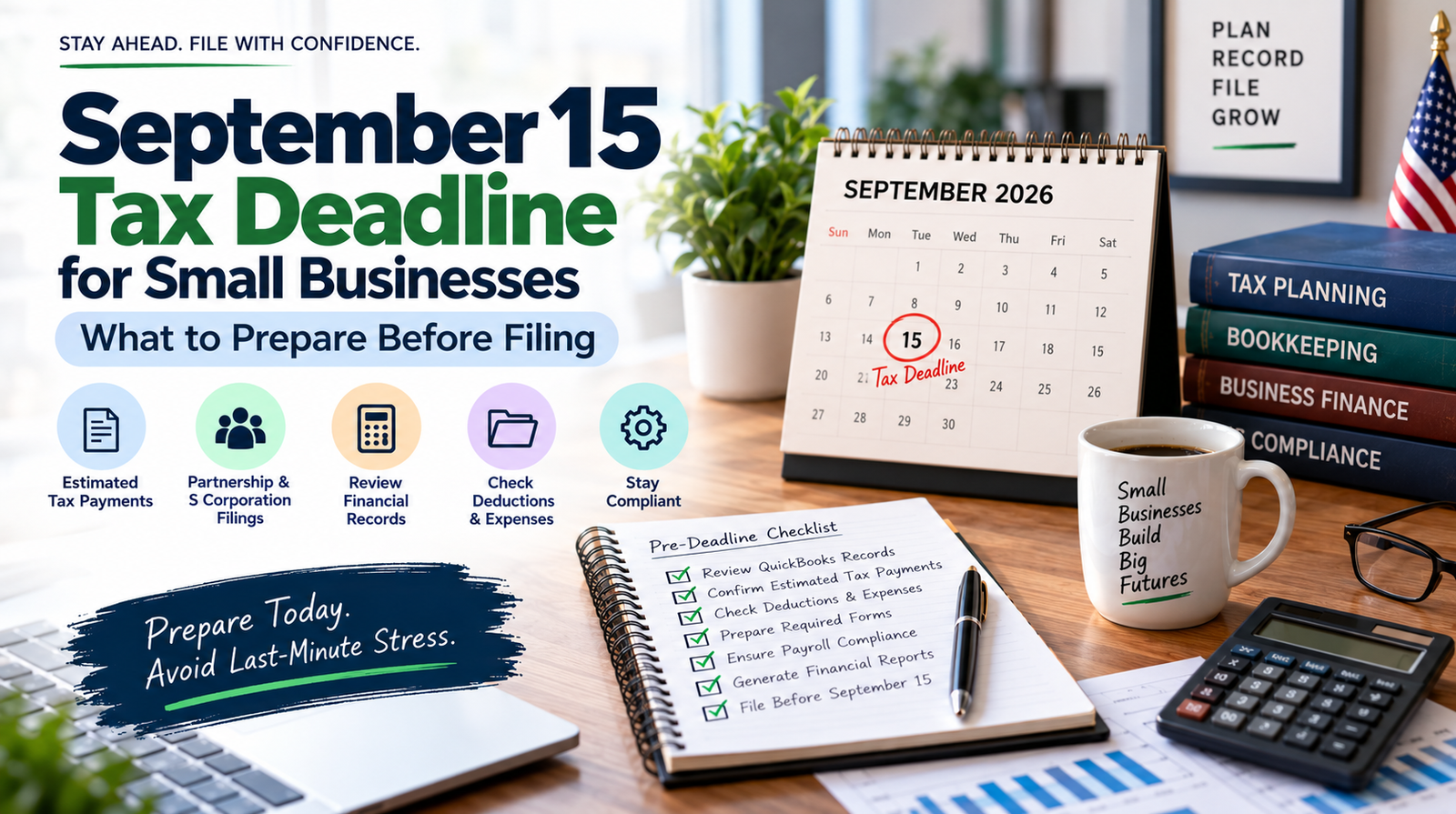

The September 15 tax deadline is an important date for many small business owners in the United States and Canada. Depending on your business structure, tax year, and filing status, September 15 may be a deadline for an estimated tax payment, an extended business tax return, or a required tax installment.
For 2026, the IRS lists September 15 as the third estimated tax payment date for individuals and as an extended filing deadline for calendar-year partnerships and S corporations that timely requested an extension. Certain corporations also have estimated tax installments due on September 15.
In Canada, September 15 is one of the regular installment dates for individuals with business, professional, or commission income who are required to make tax installments.
The important point is that September 15 does not represent the same tax obligation for every business.
This guide explains what to prepare before September 15, what records to review in QuickBooks, which financial reports to generate, and which tax items deserve attention before the deadline.
What Is the September 15 Tax Deadline?
September 15 is a major tax date because several different tax obligations can fall on this date.
| Business situation | What September 15 may mean |
| U.S. self-employed individual | Third estimated federal tax payment |
| U.S. partnership | Extended Form 1065 filing deadline if an extension was properly requested |
| U.S. S corporation | Extended Form 1120-S filing deadline if an extension was properly requested |
| Certain U.S. corporations | Estimated tax installment |
| Canadian self-employed business owner | Third income tax installment |
| Canadian corporation | Installment timing may apply depending on the corporation’s tax year and payment schedule |
The exact requirement depends on your entity type, tax year, previous filings, and whether an extension was filed.
An important distinction is that an extension to file is generally not an extension to pay. For U.S. taxpayers, the IRS specifically states that an extension of time to file does not extend the time to pay taxes owed.
Who Needs to Pay or File by September 15?
Not every small business has a September 15 filing or payment requirement.
Before preparing for the deadline, identify which category applies to your business.
U.S. sole proprietors and self-employed individuals
If you make quarterly estimated tax payments, September 15 is generally the third estimated tax payment date for calendar-year taxpayers.
The IRS divides the estimated-tax year into payment periods, with the third payment covering income from June 1 through August 31 and generally due September 15.
The amount should be based on your estimated tax liability rather than simply sending the same amount every quarter without reviewing your current income.
U.S. partnerships
A calendar-year partnership generally files Form 1065 earlier in the year.
If the partnership timely requested a six-month extension, September 15 becomes the extended filing deadline for the 2025 calendar-year return in 2026. The IRS confirms this extended deadline for calendar-year partnerships.
This means September is particularly important for partnerships that still need to finalize their books, prepare the return, and provide partners with the required information.
U.S. S corporations
Calendar-year S corporations that properly requested an extension generally have September 15 as their extended filing deadline.
The IRS identifies September 15, 2026, as the filing deadline for calendar-year Form 1120-S returns when a timely six-month extension was requested.
Before filing, review shareholder distributions, payroll, retained earnings, loans, fixed assets, and other transactions that can affect the company’s tax reporting.
U.S. corporations
Certain corporations have estimated tax installments due September 15.
The exact requirement depends on the corporation’s tax year and tax liability. The IRS 2026 tax calendar lists September 15 as the third installment date for corporate estimated tax.
Canadian self-employed business owners
For many Canadian individuals with business, professional, or commission income who are required to make tax installments, September 15 is the third 2026 installment date.
The CRA also notes that insufficient or late installments can result in interest and penalty charges.
September 15 Tax Deadline Checklist
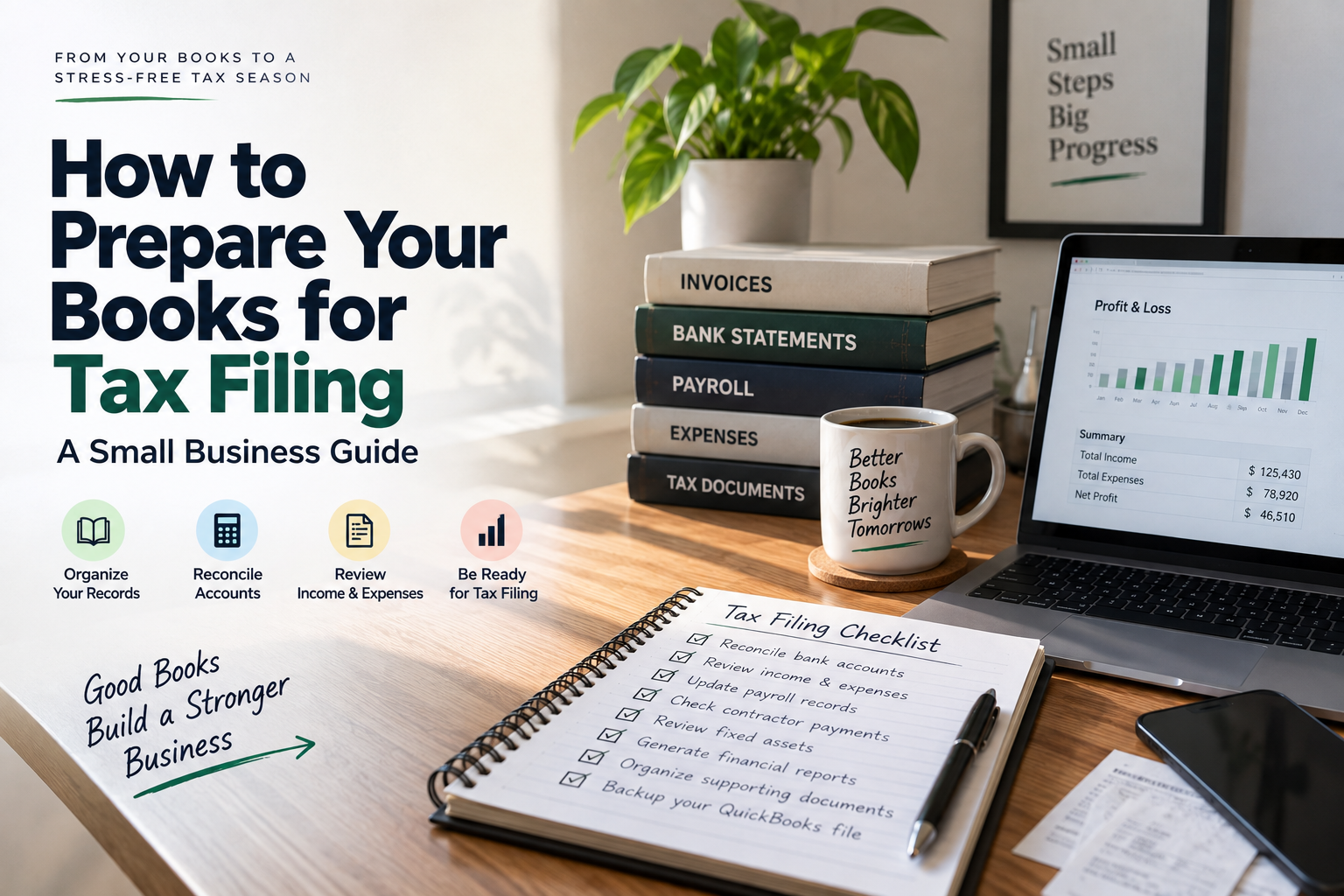
Use the following checklist before the September 15 deadline.
| Task | What to review |
| Reconcile bank accounts | Match QuickBooks balances to statements |
| Reconcile credit cards | Verify charges, payments, and balances |
| Review income | Make sure sales and other income are recorded |
| Review expenses | Check missing, duplicated, or incorrectly categorized transactions |
| Review deductions | Identify potentially deductible business expenses |
| Check accounts receivable | Investigate outstanding customer balances |
| Check accounts payable | Verify unpaid business bills |
| Review payroll | Confirm wages, taxes, and payroll liabilities |
| Review contractor payments | Check records needed for information returns |
| Review fixed assets | Confirm purchases, disposals, and depreciation information |
| Review owner transactions | Separate personal and business activity |
| Generate financial reports | Review profit and loss, balance sheet, and cash flow |
| Estimate tax liability | Update the expected tax position |
| Verify prior payments | Confirm previous estimated tax/installment payments |
| Prepare supporting records | Organize receipts, statements, invoices, and tax documents |
| Confirm filing status | Determine whether a return, extension, or payment applies |
1. Reconcile Your QuickBooks Accounts First
Your tax preparation starts with accurate accounting records.
Before calculating taxes, reconcile your:
- Business checking accounts
- Savings accounts
- Credit cards
- Business loans
- Payment processor accounts
- Payroll accounts
- Other significant balance-sheet accounts
A bank balance in QuickBooks that does not agree with the actual statement can affect reported income, expenses, cash flow, and taxable results.
If your bookkeeping is behind, completing QuickBooks bookkeeping services before preparing your tax information can help establish a cleaner starting point.
2. Review Your Year-to-Date Income
Next, review all income recorded through the latest completed period.
Look for:
- Missing sales
- Duplicate deposits
- Uncategorized deposits
- Customer payments recorded incorrectly
- Refunds and credits
- Interest income
- Other business income
- Payment processor activity
Do not assume that the amount deposited into your bank account automatically represents taxable business income.
For example, a deposit may contain multiple transactions, sales-tax amounts, refunds, transfers, or other items that require separate accounting treatment.
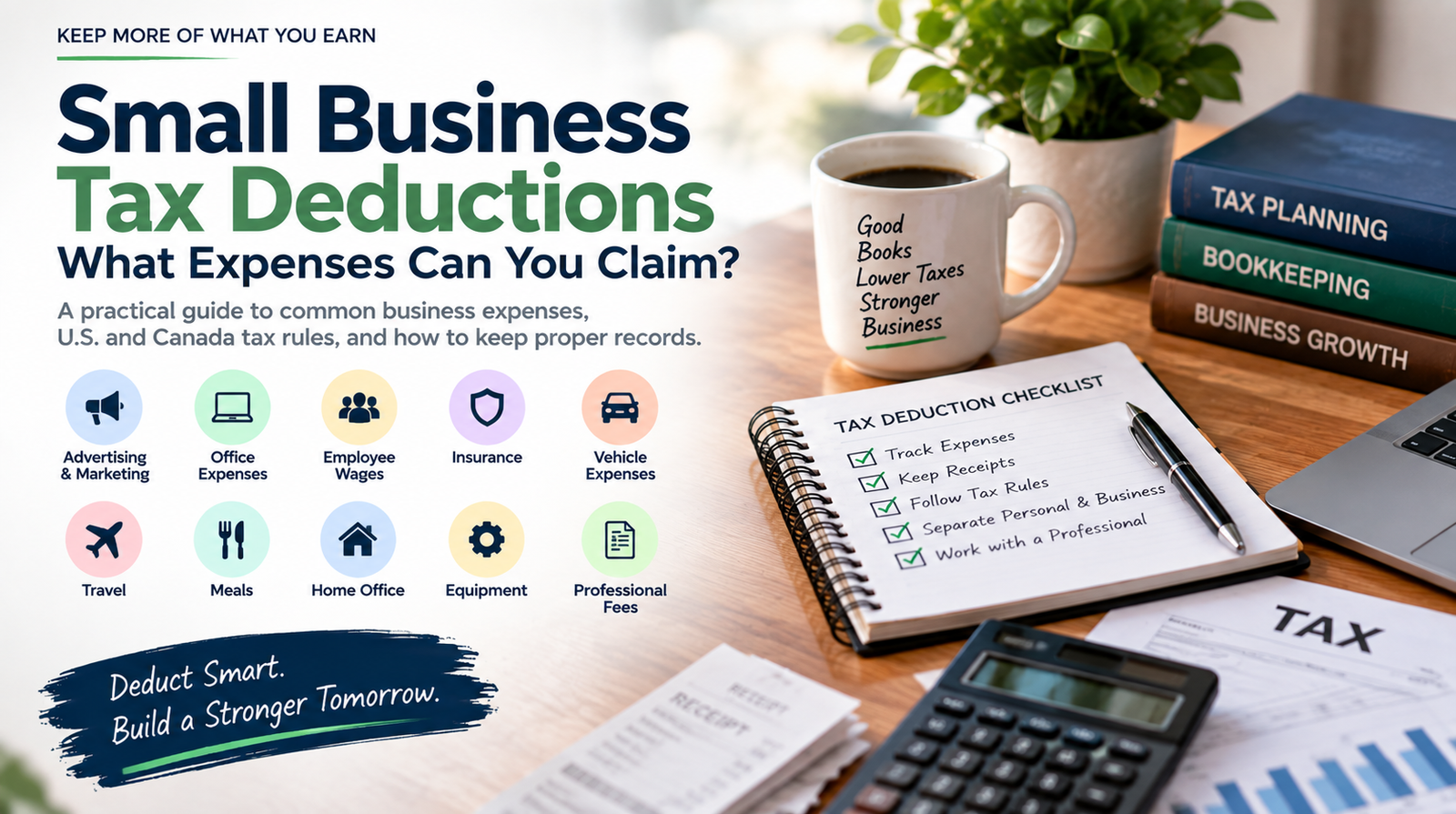
3. Review Business Expenses and Potential Deductions
September is a good time to identify expenses that may affect your taxable income.
Review categories such as:
- Advertising
- Office expenses
- Software
- Professional fees
- Insurance
- Rent
- Utilities
- Business travel
- Vehicle expenses
- Business-use-of-home expenses
- Interest and bank charges
- Repairs and maintenance
- Contractor expenses
Keep supporting documentation for expenses rather than relying only on the transaction description in QuickBooks.
If you need to review deductible expense categories, use your small business tax deductions guide as a companion resource.
4. Check Accounts Receivable and Accounts Payable
Outstanding invoices and unpaid bills can affect your financial statements and tax preparation.
Review accounts receivable for:
- Old unpaid invoices
- Duplicate invoices
- Customer credits
- Incorrect payment applications
- Potentially uncollectible balances
Then review accounts payable for:
- Unpaid vendor bills
- Duplicate bills
- Bills entered into the wrong period
- Personal expenses incorrectly recorded as business expenses
This review can also help identify cash-flow issues before the end of the year.
5. Review Payroll and Payroll Tax Records
If you have employees, compare your payroll records with the payroll liabilities shown in your accounting system.
Check:
- Gross wages
- Employer payroll taxes
- Employee withholdings
- Payroll tax liabilities
- Payroll-related payments
- Benefits
- Owner compensation where applicable
Payroll errors can create problems beyond income-tax preparation, so unresolved payroll liabilities should not be ignored simply because the September deadline is approaching.
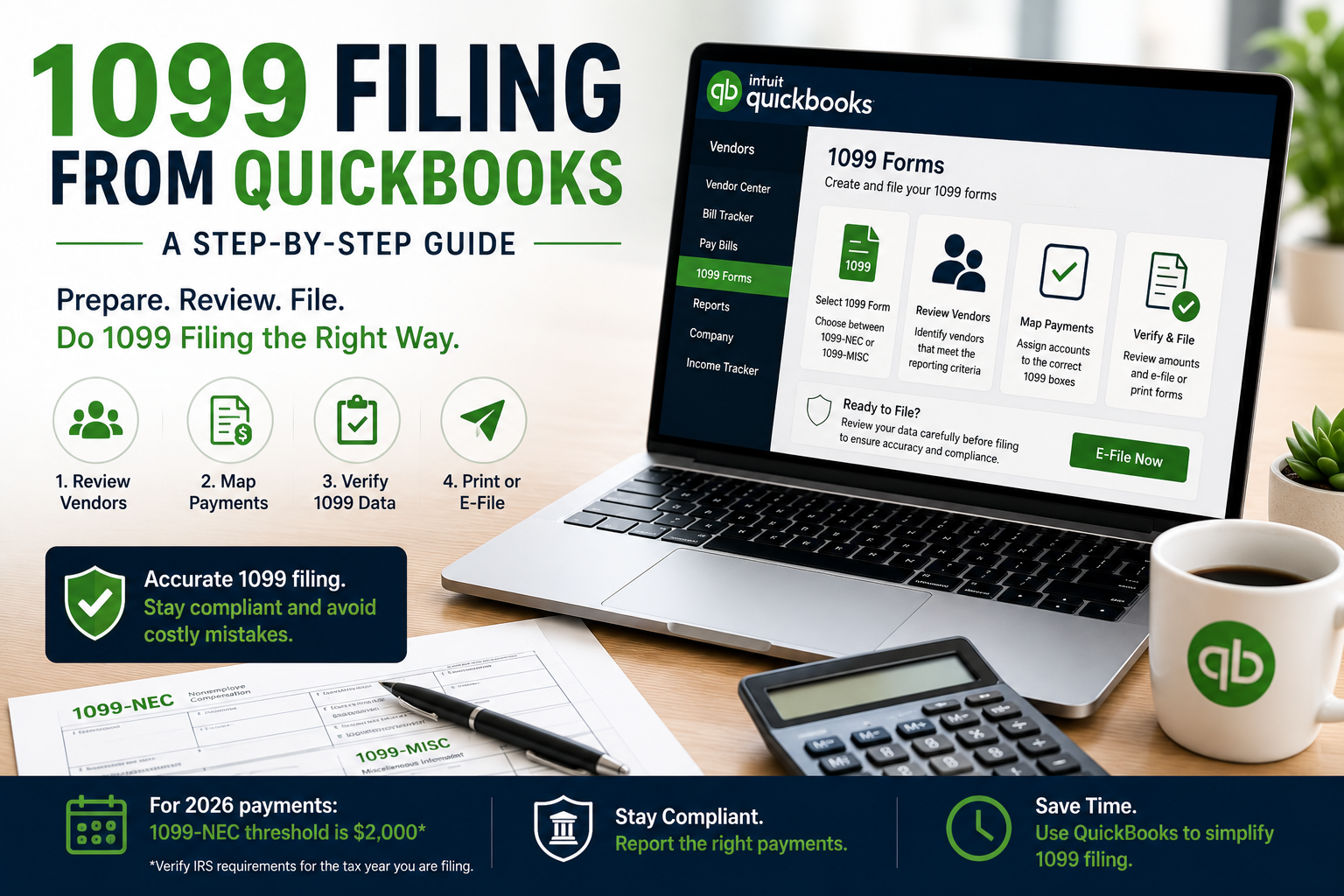
6. Review Contractor Payments
If your business pays independent contractors, review contractor transactions before the September deadline.
Confirm that:
- Vendor names are correct
- Tax identification information is available where required
- Payments are categorized correctly
- Personal payments are separated from business payments
- Payment records are complete
This is not the same as the annual 1099 filing process in QuickBooks, but reviewing contractor records now can make year-end information reporting easier.
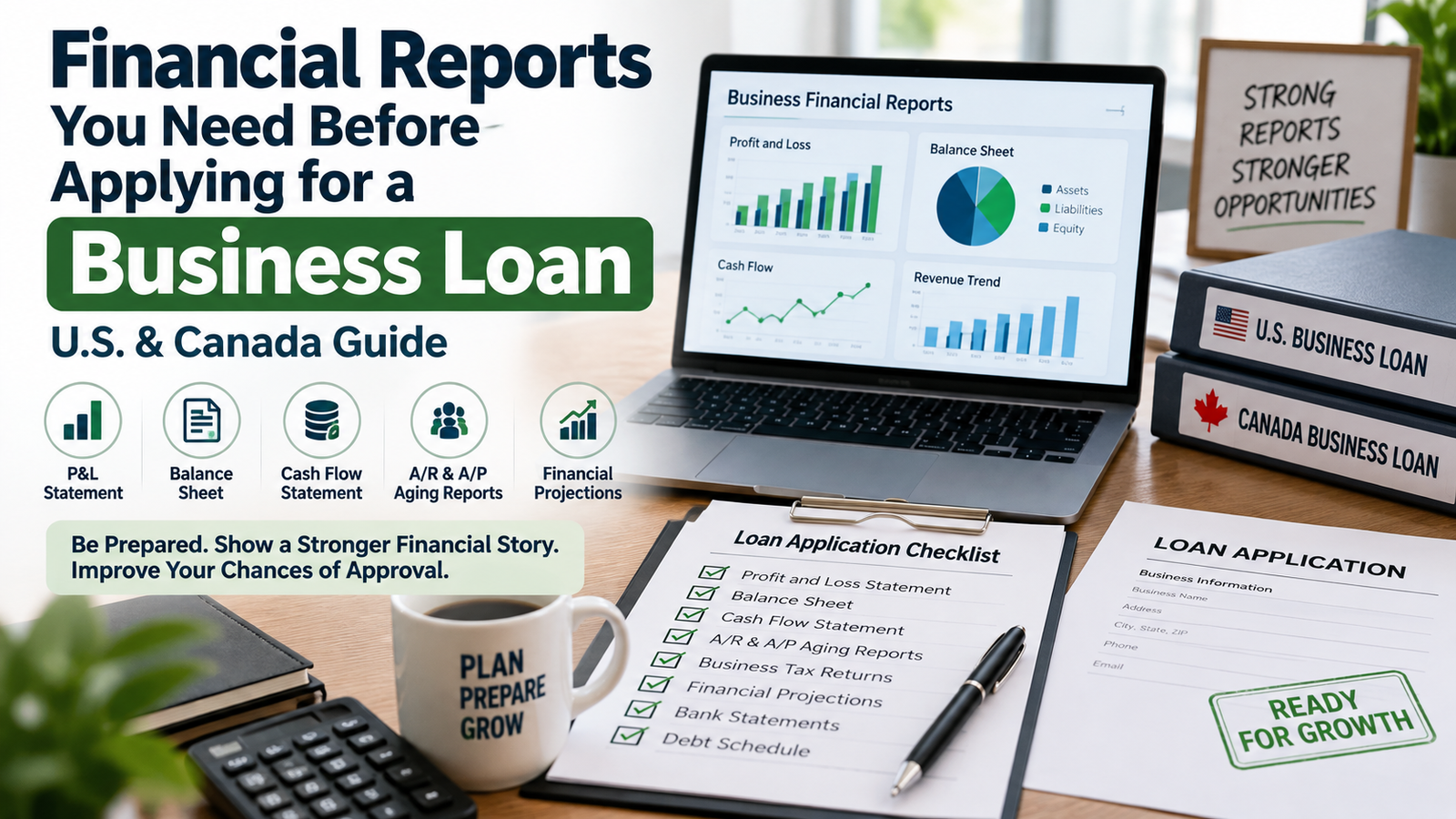
7. Generate Your Key Financial Reports
Before estimating taxes or sending records to your tax professional, generate updated financial reports.
At minimum, review:
Profit and Loss Statement
Your P&L helps you understand:
- Revenue
- Cost of goods sold
- Operating expenses
- Net profit or loss
Compare the current year with the previous year where practical.
Balance Sheet
Review:
- Cash
- Accounts receivable
- Inventory
- Fixed assets
- Loans
- Credit cards
- Accounts payable
- Equity
Unexpected balances can reveal bookkeeping issues that need to be corrected.
Cash Flow Statement
Cash flow helps you understand where money came from and where it went.
This is especially useful when your reported profit doesn’t match your actual bank balance.
For a broader explanation of how to use these reports, review your business financial reports resources.
8. Recalculate Your Estimated Tax Position
One of the most important steps before September 15 is updating your expected tax liability.
Don’t assume your previous quarterly payment is still appropriate.
Your income may have changed because of:
- Higher sales
- Lower sales
- New contracts
- New employees
- Large equipment purchases
- Changes in business expenses
- Investment income
- Business losses
- Changes in owner income
- Significant deductions
For U.S. estimated tax, the IRS notes that underpaying required installments can result in a penalty even when the taxpayer ultimately receives a refund.
Your tax professional can determine the appropriate calculation and whether safe-harbor or other rules apply.
9. Confirm Previous Tax Payments
Before making a September payment, verify what has already been paid.
Create a simple record showing:
| Period | Expected payment | Amount paid | Payment date | Status |
| First installment | — | — | — | Verify |
| Second installment | — | — | — | Verify |
| September installment | — | — | — | Prepare |
| Remaining installment | — | — | — | Future |
Check your bank statements and tax-account records rather than relying exclusively on memory.
10. Review Your Extension Status
If you are filing an extended U.S. partnership or S corporation return, confirm that the extension was actually requested on time.
Do not assume that an extension automatically means the September deadline disappears.
The IRS specifically lists September 15, 2026, as the extended deadline for calendar-year Forms 1065 and 1120-S when a timely extension was requested.
Also remember that an extension generally gives additional time to file, not additional time to pay.
11. Check for Uncategorized and Suspense Transactions
Before finalizing your reports, search QuickBooks for:
- Uncategorized income
- Uncategorized expenses
- Uncategorized assets
- Suspense transactions
- Duplicate transactions
- Missing payees
- Transfers categorized as income or expenses
- Personal transactions posted to business accounts
These items can distort your P&L and balance sheet.
Do not simply assign an account to an unknown transaction because a deadline is approaching. Review the supporting documentation first.
12. Separate Business and Personal Transactions
Mixed personal and business transactions are another common source of bookkeeping problems.
Look for:
- Personal purchases from business cards
- Owner contributions
- Owner withdrawals
- Personal payments for business expenses
- Business payments for personal expenses
The correct accounting treatment depends on your entity type and circumstances, so questionable transactions should be reviewed before the tax return is prepared.
13. Prepare Your Tax Documents
Create a September tax-preparation folder containing:
- Bank statements
- Credit-card statements
- Profit and loss report
- Balance sheet
- Cash-flow report
- Sales records
- Expense records
- Receipts
- Payroll reports
- Contractor records
- Loan statements
- Fixed-asset information
- Previous tax return
- Estimated tax payment records
- Extension confirmation, if applicable
- Other documents requested by your tax professional
Organizing these documents before filing can reduce last-minute corrections.
U.S. vs. Canada: September 15 Tax Deadline
The September 15 date exists in both countries, but the underlying obligations are different.
United States
For 2026, September 15 may involve:
- Third estimated tax payment for individuals
- Extended Form 1065 filing for calendar-year partnerships with a timely extension
- Extended Form 1120-S filing for calendar-year S corporations with a timely extension
- Corporate estimated tax installments
- Other specialized tax filings and payments
The IRS 2026 tax calendar provides the specific September 15 obligations.
Canada
For 2026, September 15 is an installment date for many individuals with business, professional, or commission income who are required to make income-tax installments.
Canadian corporations generally have monthly tax installments, although eligible corporations may qualify for quarterly installments under CRA rules. Their exact dates depend on the corporation’s tax year and circumstances.
GST/HST obligations also follow their own reporting periods and should not automatically be treated as part of the September 15 income-tax deadline. The CRA states that quarterly GST/HST filers generally file and pay one month after the end of the reporting period.
Common Mistakes to Avoid Before September 15
Waiting until September 15 to review the books
Tax preparation should not begin on the deadline itself.
Assuming the deadline applies to every business
Your business structure and tax situation determine whether September 15 applies to you.
Confusing an extension with a payment extension
An extension to file does not necessarily extend the time to pay.
Using outdated financial reports
Tax calculations based on incomplete books can produce unreliable results.
Ignoring previous estimated payments
You need to know what has already been paid before calculating what remains due.
Forgetting owner transactions
Owner draws, contributions, and personal expenses can be incorrectly classified.
Treating all September deadlines as income-tax deadlines
Payroll, sales tax, GST/HST, and other obligations can have different due dates.
What If Your QuickBooks Records Are Not Ready?
If your books are incomplete, prioritize the following:
- Reconcile bank accounts.
- Reconcile credit cards.
- Record missing income.
- Enter outstanding bills.
- Review major expenses.
- Correct obvious duplicate transactions.
- Review payroll liabilities.
- Check contractor records.
- Generate updated financial reports.
- Give your tax professional the supporting documentation.
If the accounting records contain significant errors, consider getting professional bookkeeping or accounting services before finalizing your tax information.
September 15 Tax Deadline: Final Checklist
Before September 15, confirm that you have:
- Identified the tax obligation that applies to your business
- Reconciled bank accounts
- Reconciled credit cards
- Reviewed year-to-date income
- Reviewed expenses
- Checked potentially deductible expenses
- Reviewed accounts receivable
- Reviewed accounts payable
- Checked payroll records
- Reviewed contractor payments
- Checked fixed assets
- Reviewed owner transactions
- Removed or investigated uncategorized transactions
- Generated a current P&L
- Generated a current balance sheet
- Reviewed cash flow
- Verified previous tax payments
- Updated the estimated tax calculation
- Confirmed extension status if applicable
- Organized supporting documents
- Confirmed the actual filing/payment deadline
- Reviewed the final information with your tax professional when appropriate
Frequently Asked Questions
Is September 15 a tax deadline for all small businesses?
No. September 15 applies to specific taxpayers and business situations. In the U.S., it is commonly associated with the third estimated tax payment and extended partnership and S corporation filing deadlines. In Canada, it is an installment date for many individuals with business, professional, or commission income.
What is due September 15, 2026 for a U.S. small business?
Depending on the business, September 15, 2026 may be the date for an estimated tax payment, an extended Form 1065 or Form 1120-S filing, or a corporate estimated tax installment. Other specialized obligations can also apply.
Is September 15 an estimated tax payment deadline?
For U.S. calendar-year individuals who make quarterly estimated tax payments, September 15, 2026 is the third estimated tax payment date.
Is September 15 a Canadian tax deadline?
For many Canadian individuals with business, professional, or commission income who are required to make installments, September 15, 2026 is the third income-tax installment date.
Does a tax extension give me more time to pay?
Generally, an extension to file does not extend the time to pay U.S. taxes. The IRS specifically distinguishes the filing extension from the payment obligation.
What QuickBooks reports should I review before September 15?
At minimum, review your Profit and Loss, Balance Sheet, and Cash Flow reports. You should also review accounts receivable, accounts payable, payroll liabilities, fixed assets, and owner transactions.
What should I do if my books are not reconciled?
Complete the most important reconciliations first, identify missing or duplicate transactions, update income and expenses, and generate current financial reports. If significant accounting issues remain, seek professional bookkeeping or accounting assistance before finalizing your tax information.
Final Takeaway
The September 15 tax deadline for small businesses is not simply a date to put on your calendar. It is a reason to review your books, tax payments, financial reports, deductions, and filing status before the deadline arrives.
For U.S. businesses, September 15, 2026 can involve estimated tax payments and extended partnership or S corporation filings. For many Canadian self-employed business owners, it is the third 2026 income-tax installment date.
The best approach is to prepare early: reconcile QuickBooks, review your income and expenses, verify previous payments, generate current financial reports, organize supporting records, and confirm the specific obligation that applies to your business.
For tax-specific questions or filing decisions, verify the current requirements with the IRS, CRA, or your qualified tax professional because deadlines and requirements can vary by entity, tax year, and circumstances.
References:
https://www.irs.gov/businesses/small-businesses-self-employed/third-quarter-tax-calendar