

Business expenses can significantly affect your taxable income, but not every expense you pay for your business is automatically deductible.
For U.S. businesses, the IRS generally requires a business expense to be ordinary and necessary to be deductible. An ordinary expense is common and accepted in the business or profession, while a necessary expense is helpful and appropriate for the business. Personal expenses generally cannot be deducted.
Canadian businesses follow different rules. The CRA generally allows reasonable current expenses incurred to earn business income, while personal expenses and capital expenditures are treated differently.
That distinction matters if your business operates in the U.S. or Canada—or if you are comparing tax treatment across both countries.
This guide explains common small business tax deductions, expenses that require special treatment, records you should maintain, and how to organize deductible expenses in QuickBooks.
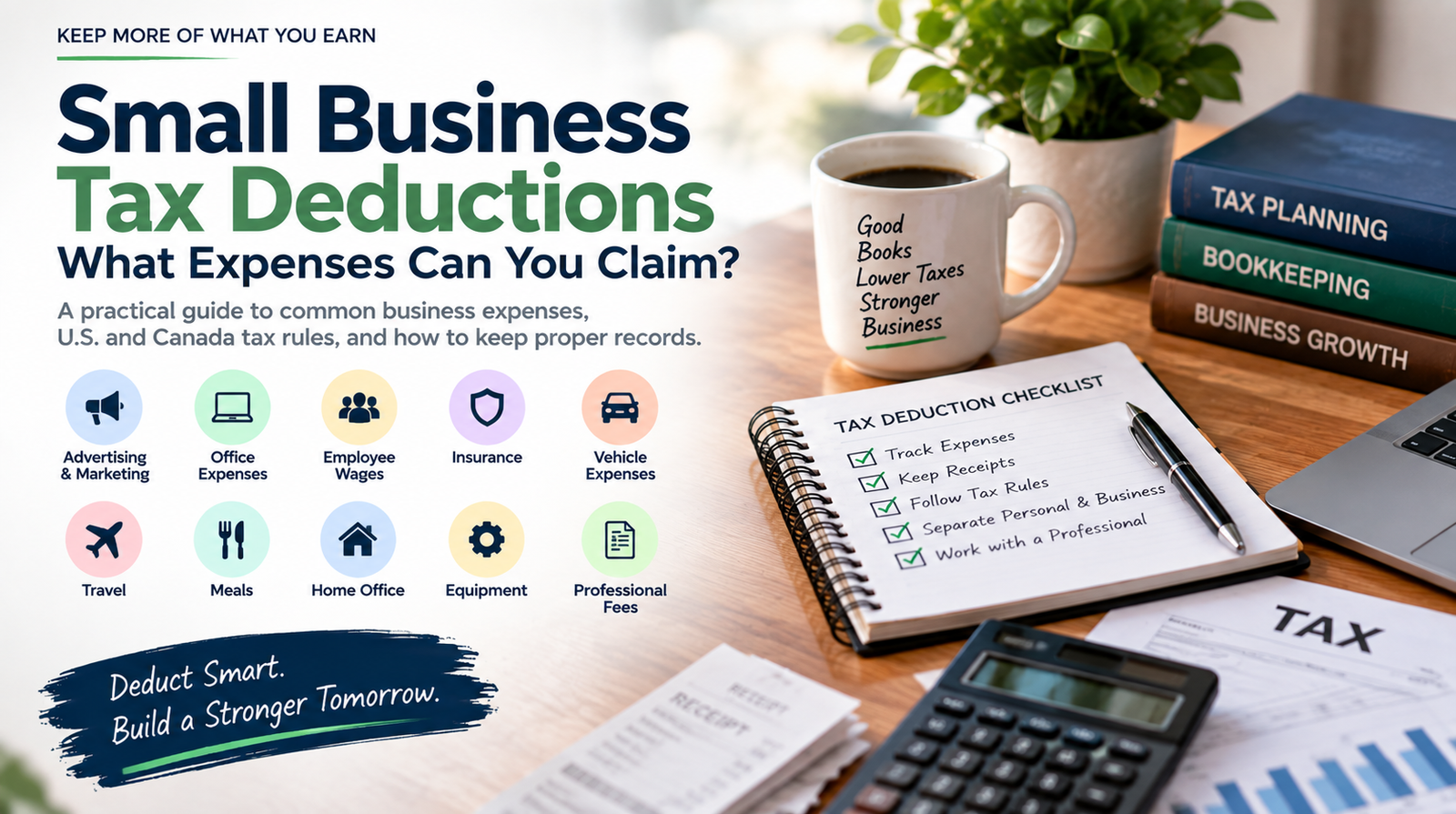
Quick answer: Common potentially deductible business expenses include advertising, office expenses, professional fees, insurance, business-use vehicle costs, travel, certain meals, employee wages, interest, rent, utilities, repairs, and supplies. However, eligibility and deduction limits depend on the country, business structure, type of expense, and how the expense is used.
Small Business Tax Deductions at a Glance
| Expense Category | U.S. | Canada | Important Consideration |
| Advertising | Generally deductible | Generally deductible | Specific restrictions can apply |
| Office supplies | Generally deductible | Generally deductible | Capital equipment may be treated differently |
| Professional fees | Generally deductible | Generally deductible | Personal services are generally excluded |
| Business insurance | Generally deductible | Generally deductible | Must relate to the business |
| Rent | Generally deductible | Generally deductible | Business use matters |
| Utilities | Generally deductible | Generally deductible | Personal portion may need to be excluded |
| Employee wages | Generally deductible | Generally deductible | Payroll rules apply |
| Business travel | Generally deductible subject to rules | Generally deductible subject to rules | Documentation is important |
| Meals | Limited in many situations | Generally subject to limits | Rules differ by country |
| Vehicle expenses | Business-use rules apply | Business-use rules apply | Personal use must be separated |
| Home office | Special rules apply | Special rules apply | Eligibility requirements differ |
| Equipment | May require depreciation or other treatment | May require CCA or other treatment | Not always a current expense |
| Loan interest | May be deductible when related to business | May be deductible when related to business | Limitations can apply |
This table is a starting point—not a determination that a particular expense is deductible in every situation.
What Is a Small Business Tax Deduction?
A tax deduction is an expense or amount that tax rules allow you to subtract when determining taxable business income.
The exact mechanism depends on your business structure and tax jurisdiction.
For U.S. taxpayers, deductible business expenses generally need to be ordinary and necessary. The IRS also distinguishes current business expenses from costs that must be capitalized or otherwise treated differently.
In Canada, the CRA generally allows reasonable current expenses incurred to earn business income. Capital property is treated separately, and personal expenses cannot be claimed as business expenses.
So the better question is not:
“Did my business pay for it?”
Instead, ask:
“Was this expense incurred for the business, is it allowable under the applicable tax rules, and do I have adequate records to support it?”
1. Advertising and Marketing Expenses
Advertising is one of the most common business expenses.
Depending on the circumstances, this can include:
- Online advertising
- Search advertising
- Social media advertising
- Website-related marketing
- Print advertising
- Promotional materials
- Business signage
- Marketing services
- Certain sponsorships
- Promotional campaigns
For U.S. businesses, ordinary and necessary advertising expenses are generally deductible.
Canada also generally permits advertising expenses, although specific restrictions can apply to certain types of advertising and media.
QuickBooks tip
Create a dedicated advertising or marketing expense category instead of combining every marketing-related transaction into a general expense account.
This makes your year-end financial reports easier to review.
2. Office Supplies and Business Supplies
Common office expenses may include:
- Paper
- Pens
- Printer supplies
- Envelopes
- Stationery
- Small business supplies
- Packaging materials
- Other consumable supplies
Canada specifically distinguishes small office expenses from capital items such as desks, filing cabinets, and other longer-term assets.
The U.S. treatment similarly depends on the nature of the purchase and whether the cost is a current business expense or should be capitalized.
Important distinction
Buying a box of printer paper is different from buying a $5,000 piece of equipment.
Do not automatically categorize every business purchase as an ordinary expense.
3. Professional and Accounting Fees
Professional fees can include:
- Accounting services
- Bookkeeping
- Tax preparation
- Legal services
- Business consulting
- Professional advice
- Certain specialized services
The IRS allows ordinary and necessary legal and professional expenses directly related to operating a business, subject to applicable rules.
The CRA also allows certain accounting, legal, and professional fees incurred for business purposes.
This can be particularly relevant when maintaining your accounting records, preparing tax returns, or obtaining professional business advice.
4. Business Insurance
Businesses may have several types of insurance, such as:
- General liability insurance
- Professional liability insurance
- Commercial property insurance
- Business interruption coverage
- Certain commercial vehicle insurance
- Equipment insurance
Business-related insurance costs may be deductible when they meet the applicable tax requirements.
Canada’s CRA specifically lists commercial insurance among operating expenses that may be deductible.
Keep the insurance invoices, policy information, and payment records with your business records.
5. Rent for Business Property
If your business rents:
- Office space
- Retail space
- Warehouse space
- Workshop space
- Commercial equipment
the rental cost may qualify as a business expense depending on the circumstances.
Keep:
- Lease agreements
- Rent invoices
- Payment records
- Security deposit documentation
- Records of any rent adjustments
If part of a property is used personally, you generally cannot simply treat the entire cost as a business deduction.
6. Utilities and Communication Costs
Business-related operating costs can include:
- Electricity
- Water
- Gas
- Internet
- Business telephone
- Business cellphone
- Other qualifying utilities
The business portion should be separated from personal use when an expense serves both purposes.
Canada specifically allows business-related telephone and utility expenses, while home-use expenses are subject to separate rules.
7. Employee Wages and Benefits
Employee-related costs can represent a major business expense.
Depending on the business and jurisdiction, potentially deductible costs can include:
- Salaries
- Wages
- Employer payroll costs
- Certain employee benefits
- Other qualifying compensation
Canada’s CRA specifically lists salaries, wages, and benefits, including employer contributions, among operating expenses.
Payroll deductions and employer obligations are separate from simply recording the wage expense, so make sure payroll liabilities are properly tracked.
8. Business Travel Expenses
Business travel may include:
- Airfare
- Hotels
- Ground transportation
- Rental vehicles
- Parking
- Business-related travel costs
- Certain meals while traveling
The expense generally needs to be connected to business activity.
Keep documentation showing:
- Date
- Location
- Business purpose
- Amount
- Vendor
- Payment method
- Supporting receipt
Canada’s CRA allows travel expenses incurred to earn business income, but meals and entertainment are generally subject to a 50% limit, subject to exceptions.
U.S. travel and meal rules have their own requirements and limitations, so do not automatically apply Canadian percentages to U.S. expenses or vice versa.
9. Business Meals
Meals are one of the most commonly misunderstood business deductions.
A meal purchased during business activity does not automatically become fully deductible.
The rules can depend on:
- Who attended
- Business purpose
- Location
- Whether travel was involved
- Whether the expense was reasonable
- Applicable deduction limits
- Country and tax year
In Canada, the CRA generally limits deductible food, beverages, and entertainment expenses to 50% of the amount incurred or a reasonable amount, whichever is less, subject to specific exceptions.
U.S. meal deduction rules are different.
What to record
For every potentially deductible business meal, keep:
- Receipt
- Date
- Amount
- Attendees or business relationship
- Business purpose
Do not rely solely on the transaction description in your bank feed.
10. Business Vehicle Expenses
If you use a vehicle for business purposes, you may be able to claim qualifying business-use vehicle costs.
Depending on the circumstances, these may include:
- Fuel
- Repairs
- Maintenance
- Insurance
- Registration
- Parking
- Lease costs
- Interest
- Depreciation or other capital-related deductions
The calculation is more complicated when a vehicle is used for both business and personal purposes.
Canada’s CRA lists fuel, insurance, interest, maintenance, repairs, leasing costs, and certain other vehicle costs among potentially deductible expenses, with specific rules and limits.
Keep a mileage or usage record
Your records should make it possible to determine the business portion of vehicle use.
A simple bank transaction showing “gas station” does not by itself prove that the entire purchase was business-related.
11. Home Office Expenses
Working from home does not automatically mean every household expense is deductible.
Home-office rules differ significantly between the U.S. and Canada.
Potential expenses can include a portion of:
- Rent
- Utilities
- Insurance
- Maintenance
- Property-related costs
- Other qualifying home expenses
However, eligibility requirements and calculation methods vary.
For example, the CRA says business-use-of-home expenses can generally be claimed when the workspace is the main place of business or is used only to earn business income and regularly to meet clients, customers, or patients.
For U.S. businesses, the home-office deduction has its own eligibility and calculation rules.
Important
Do not simply create a “Home Office” expense account and enter a percentage of every household bill without determining whether the expense qualifies and how the deduction should be calculated.
12. Business Interest and Bank Charges
Businesses may incur:
- Bank fees
- Merchant processing fees
- Business loan interest
- Line-of-credit interest
- Certain financing charges
These expenses may be deductible when they meet applicable requirements.
Canada’s CRA specifically identifies interest and bank charges among business operating expenses, while noting that limits can apply in certain circumstances.
Separate:
- Interest
- Principal repayments
- Bank charges
- Loan fees
A loan principal repayment is not simply the same type of expense as interest.
13. Repairs and Maintenance
Routine repairs and maintenance may qualify as business expenses.
Examples can include:
- Equipment maintenance
- Building repairs
- Routine servicing
- Minor repairs
- Maintenance contracts
However, major improvements or purchases may need to be treated as capital expenditures rather than current expenses.
Canada’s CRA specifically distinguishes current repairs from capital expenditures.
This distinction matters because capital costs are generally recovered through different tax mechanisms rather than being deducted entirely as an ordinary operating expense in the year purchased.
14. Business Taxes, Licenses, and Fees
Depending on the jurisdiction and business activity, potentially deductible costs may include:
- Business licenses
- Professional licenses
- Certain regulatory fees
- Business association dues
- Certain business taxes
- Permits
Canada’s CRA specifically lists business taxes, licenses, fees, and certain membership dues among operating expenses.
Always distinguish business-related fees from personal memberships or expenses that do not qualify.
15. Software and Technology Expenses
Modern businesses commonly pay for:
- Accounting software
- Cloud software
- Payroll software
- Project management platforms
- Website services
- Business email
- Cybersecurity tools
- Cloud storage
- Design software
- Business subscriptions
The tax treatment can depend on the nature and duration of the expense.
For example, an ordinary subscription may be treated differently from the purchase of long-term technology equipment.
Record these expenses consistently in QuickBooks so you can review them at year-end.
16. Bad Debts
Some businesses may have customers who fail to pay their invoices.
Bad-debt treatment is highly dependent on accounting method and tax rules.
In Canada, the CRA says a bad debt may generally be deductible when the receivable was determined to be bad and had previously been included in income.
Do not simply delete an unpaid customer invoice and call it a tax deduction.
Review the appropriate accounting and tax treatment first.
17. Business Start-Up Costs
Start-up expenses can be complicated because the date the business actually began operations can matter.
Canada’s CRA specifically notes that determining the treatment of start-up expenses can be difficult because it is necessary to establish when the business commenced.
U.S. tax rules also contain specific provisions for start-up costs.
Keep documentation for expenses incurred before and around the beginning of business operations rather than assuming every pre-launch expense receives the same treatment.
18. Inventory and Cost of Goods Sold
Businesses that sell products may have costs related to:
- Inventory purchases
- Raw materials
- Manufacturing
- Packaging
- Direct labor
- Other costs associated with producing or acquiring goods
These costs are not always treated the same way as ordinary operating expenses.
Canada’s CRA specifically addresses inventory and cost of goods sold separately from ordinary operating expenses.
If your business maintains inventory, make sure your QuickBooks records accurately reflect purchases, inventory, and cost of goods sold.
Expenses You Should Not Automatically Claim as Business Deductions
One of the biggest tax mistakes is assuming that anything paid from a business bank account is deductible.
Be careful with:
- Personal groceries
- Personal clothing
- Personal vacations
- Personal entertainment
- Personal vehicle expenses
- Personal household expenses
- Owner draws
- Owner distributions
- Personal memberships
- Fines and penalties
- Capital purchases treated as ordinary expenses
- Expenses with no supporting documentation
For U.S. taxpayers, the IRS states that the personal portion of a mixed business/personal expense is generally not deductible.
The CRA likewise states that personal expenses cannot be claimed as business expenses and that only the business portion of qualifying mixed-use expenses should be claimed.
Current Expenses vs. Capital Expenses
This is one of the most important distinctions for small businesses.
Current expense
A current expense generally relates to the ongoing operation of the business and may be deductible under the applicable rules for the year.
Examples can include:
- Office supplies
- Advertising
- Routine repairs
- Rent
- Utilities
- Certain professional fees
Capital expense
A capital expense generally relates to acquiring or improving a longer-term asset.
Examples can include:
- Major equipment
- Machinery
- Certain vehicles
- Buildings
- Significant improvements
- Long-term property
The tax treatment is different.
In Canada, capital property generally cannot simply be deducted as a current expense; capital cost allowance may apply instead.
U.S. businesses may also need to capitalize certain costs and recover them through depreciation or other applicable provisions.
Do not force a capital purchase into an ordinary expense category simply to increase current-year deductions.
Business Expenses Used for Both Personal and Business Purposes
Mixed-use expenses require additional care.
Examples include:
- Cellphones
- Internet
- Vehicles
- Home-office costs
- Computers
- Travel
- Certain subscriptions
Suppose a cellphone is used 70% for business and 30% personally.
You generally cannot treat 100% of the cost as a business expense simply because the phone is used for work.
The appropriate business portion needs to be determined under the applicable tax rules and supported by reasonable records.
How to Track Tax-Deductible Expenses in QuickBooks
QuickBooks can make expense tracking much easier, but accurate tax reporting depends on how transactions are entered and categorized.
Create meaningful expense categories
Instead of placing everything under “Business Expenses,” use appropriate categories such as:
- Advertising
- Office supplies
- Insurance
- Professional fees
- Rent
- Utilities
- Travel
- Meals
- Vehicle expenses
- Software
- Repairs and maintenance
- Interest and bank charges
Your accountant or tax professional can help determine the categories appropriate for your business.
Reconcile your accounts
Reconcile business bank accounts and credit cards regularly.
This helps identify:
- Missing transactions
- Duplicate transactions
- Incorrect amounts
- Personal expenses
- Misclassified transactions
Attach or retain supporting documentation
Keep receipts, invoices, statements, contracts, and other documentation that supports the expense.
The CRA specifically says business expense claims should be supported by documents such as sales invoices, agreements, receipts, or other vouchers.
Separate personal transactions
If a personal expense accidentally enters your QuickBooks bank feed, do not leave it categorized as a business expense.
Reclassify it appropriately.
Review expenses before tax preparation
A year-end review can identify:
- Uncategorized expenses
- Duplicate transactions
- Personal expenses
- Incorrect categories
- Missing receipts
- Capital purchases incorrectly expensed
This is where clean bookkeeping becomes particularly valuable.
Small Business Tax Deduction Checklist
Before sending your books to your tax preparer, review:
Income and expenses
- All business income is recorded
- Business expenses are categorized
- Duplicate transactions are removed
- Personal expenses are separated
- Uncategorized transactions are reviewed
Common deductions
- Advertising
- Office supplies
- Software
- Professional fees
- Insurance
- Rent
- Utilities
- Employee wages
- Business travel
- Meals
- Vehicle expenses
- Repairs and maintenance
- Interest and bank charges
- Business licenses and fees
Special categories
- Home-office expenses reviewed
- Capital purchases identified
- Inventory reviewed
- Bad debts reviewed
- Start-up expenses reviewed
- Mixed-use expenses allocated correctly
Documentation
- Receipts retained
- Invoices retained
- Bank statements reconciled
- Credit cards reconciled
- Mileage/business-use records maintained
- Supporting documents organized
How to Avoid Missing Small Business Tax Deductions
The biggest problem is often not knowing that a deduction exists—it is failing to record and document the expense correctly.
A good process is:
Record → Categorize → Reconcile → Document → Review
Record
Enter the transaction promptly.
Categorize
Assign it to the correct accounting category.
Reconcile
Confirm the transaction against the bank or credit card statement.
Document
Keep the receipt, invoice, or other supporting record.
Review
Before tax preparation, review the category and supporting documentation.
This process helps create cleaner financial records and makes it easier to identify potentially deductible expenses.
What Records Should You Keep for Business Tax Deductions?
The exact retention period varies by country and type of record, but businesses should maintain enough documentation to support their tax filings.
Useful records can include:
- Receipts
- Invoices
- Bank statements
- Credit card statements
- Mileage logs
- Contracts
- Lease agreements
- Payroll records
- Loan statements
- Asset purchase records
- Business-use calculations
- Travel records
- Meal documentation
For Canadian businesses, the CRA specifically requires supporting documentation for business expense claims.
For U.S. businesses, the IRS similarly expects taxpayers to maintain records supporting income and deductions.
U.S. vs. Canada: Why You Should Not Use the Same Deduction Rules
A business expense can be treated differently in the U.S. and Canada.
For example:
- Meal deduction limits differ.
- Vehicle rules differ.
- Home-office requirements differ.
- Capital-cost rules differ.
- Tax treatment of certain professional and financing costs differs.
- Recordkeeping requirements differ.
Therefore, a deduction list written for a U.S. taxpayer should not automatically be applied to a Canadian business.
If your business operates in both countries, obtain country-specific tax advice rather than assuming the same expense treatment applies to both.
When Should You Review Your Business Tax Deductions?
Do not wait until the tax filing deadline.
A better approach is to review expenses throughout the year.
Monthly
- Categorize transactions
- Reconcile bank accounts
- Review unusual expenses
Quarterly
- Review expense categories
- Check for missing documentation
- Review major purchases
- Separate personal and business transactions
Before tax preparation
- Reconcile all relevant accounts
- Review expense categories
- Identify capital purchases
- Review mixed-use expenses
- Gather supporting documentation
- Generate final financial reports
If your bookkeeping is already behind, completing this review before tax preparation can prevent avoidable delays.
What If Your QuickBooks Expenses Are Messy?
If your QuickBooks file contains years of:
- Uncategorized transactions
- Duplicate expenses
- Unreconciled accounts
- Incorrect expense categories
- Personal transactions
- Missing documentation
- Incorrect opening balances
do not simply estimate the deductions from your bank statements.
The accounting records should be cleaned and reviewed first.
Professional QuickBooks bookkeeping services can help organize transactions, reconcile accounts, review expense classifications, and prepare cleaner financial records before tax preparation.
If your books are already organized but you need help preparing tax-related financial information, taxation services can provide a more appropriate next step.
Frequently Asked Questions
What are the most common small business tax deductions?
Common categories include advertising, office expenses, professional fees, insurance, rent, utilities, employee wages, travel, meals, vehicle expenses, repairs, interest, and software. The exact deduction depends on the applicable tax rules and the nature of the expense.
Can I deduct everything I buy for my business?
No. An expense generally must meet the applicable tax requirements, and personal expenses generally cannot be claimed as business deductions. Capital purchases may also require different tax treatment.
Are business meals tax deductible?
Potentially, but meal deductions are subject to specific rules and limitations. Canada generally applies a 50% limit to many meal and entertainment expenses, while U.S. rules are different.
Can I deduct my home office?
Potentially. Both the U.S. and Canada have specific eligibility and calculation rules for business use of a home. You should determine whether you qualify before claiming the deduction.
Can I deduct my business vehicle?
Potentially. The deductible amount generally depends on business use and the applicable vehicle rules. Keep records that support the business portion of vehicle use.
Are QuickBooks and accounting software tax deductible?
Business-use software expenses may be deductible when they meet the applicable requirements. The appropriate treatment can depend on the nature, cost, and duration of the software or service.
Are accounting and bookkeeping fees deductible?
Business-related accounting and professional fees may qualify as deductible expenses under applicable rules. Canada specifically identifies accounting and legal fees related to business activities among potentially deductible expenses.
Can I deduct personal expenses paid from my business bank account?
Generally, you should not treat personal expenses as deductible business expenses merely because they were paid from a business account. The personal portion of mixed expenses generally needs to be separated.
Should I categorize expenses in QuickBooks by tax deduction?
QuickBooks categories should accurately describe the accounting nature of the transaction. Tax treatment can involve additional rules, adjustments, and decisions that should be reviewed with a tax professional.
What happens if I claim a business expense without a receipt?
You may have difficulty supporting the deduction if the tax authority asks for evidence. Maintain appropriate documentation for business expenses and follow the recordkeeping rules applicable to your jurisdiction.
Final Small Business Tax Deduction Checklist
Before your books go to your tax preparer, make sure you have:
- Recorded all business income
- Categorized business expenses correctly
- Reconciled bank accounts
- Reconciled business credit cards
- Separated personal expenses
- Reviewed advertising costs
- Reviewed office expenses
- Reviewed software and technology costs
- Reviewed professional fees
- Reviewed insurance
- Reviewed rent and utilities
- Reviewed employee costs
- Reviewed travel
- Reviewed meals
- Reviewed vehicle expenses
- Reviewed home-office expenses
- Identified capital purchases
- Reviewed inventory and cost of goods sold
- Reviewed interest and bank charges
- Retained receipts and supporting documents
- Reviewed unusual or high-value transactions
Final Takeaway
Small business tax deductions can reduce taxable business income, but not every business expense is automatically deductible.
For U.S. businesses, the IRS generally requires an expense to be ordinary and necessary, while Canada generally focuses on reasonable current expenses incurred to earn business income. Both jurisdictions distinguish business expenses from personal costs and apply special rules to areas such as meals, vehicles, home offices, and capital expenditures.
The best way to avoid missed or unsupported deductions is to maintain accurate books throughout the year, categorize transactions consistently, reconcile your accounts, and retain documentation for your expenses.
If your QuickBooks records are not organized, clean bookkeeping should come before trying to identify every possible deduction. Once your records are accurate, your tax professional can make the appropriate tax decisions based on your business and jurisdiction.
Tax rules change, and eligibility can depend on your business structure, location, accounting method, and the specific expense. Always verify current rules with the IRS, CRA, or a qualified tax professional before filing.