

Applying for a business loan is not just about showing how much money you want to borrow. Lenders also need to understand your business’s financial health, profitability, existing obligations, available cash, and ability to repay the proposed debt.
That is why having accurate, current, and well-organized financial reports for a business loan can make the application process much easier.
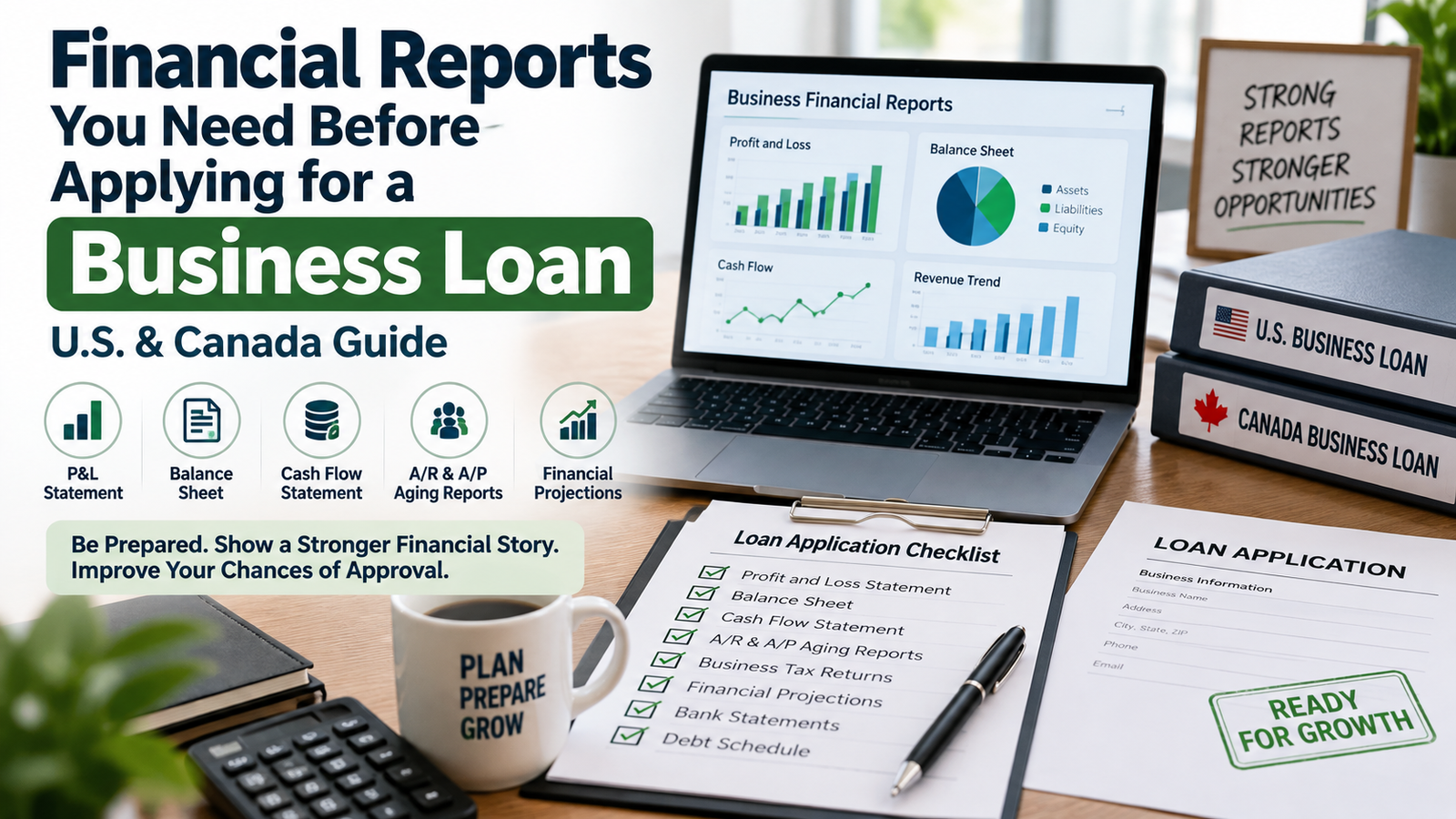
For many businesses, the core reports include a Profit and Loss Statement, Balance Sheet, and Cash Flow Statement. Depending on the lender, loan size, business age, and financing program, you may also need accounts receivable and payable aging reports, debt schedules, tax returns, financial projections, bank statements, and other supporting documents.
The U.S. Small Business Administration notes that established businesses seeking funding should include historical income statements, balance sheets, and cash flow statements, while financial projections can also be required. (Small Business Administration) In Canada, BDC says financial institutions typically review financial statements to understand a company’s financial health, profitability, and ability to repay debt. (BDC.ca)
If your accounting records are maintained in QuickBooks Desktop, preparing lender-ready reports starts with making sure the underlying books are complete and reconciled.
Quick Answer: What Financial Reports Do You Need for a Business Loan?
Most businesses should be prepared to provide some combination of:
- Profit and Loss Statement
- Balance Sheet
- Cash Flow Statement
- Accounts Receivable Aging Report
- Accounts Payable Aging Report
- Business debt or loan schedule
- Financial projections or cash flow forecast
- Recent bank statements
- Business tax returns
- Personal financial information or guarantees, when requested
Not every lender requires every report. Requirements can vary based on the lender, loan type, loan amount, business structure, industry, and location.
For example, the SBA states that loan-application contents vary by loan size and lender processing method, and that the lender determines what documents are needed for an individual application.
Why Lenders Want Financial Reports
A lender is primarily trying to answer a few important questions:
- Is the business financially healthy?
- Is the business profitable?
- Does it generate enough cash to repay the loan?
- How much debt does the business already have?
- What assets and liabilities does the business have?
- Are sales and expenses consistent?
- How much money is the owner requesting?
- What will the loan be used for?
- Does the business have a reasonable plan for repayment?
Financial reports help the lender evaluate these questions using documented financial information rather than relying only on projections or verbal explanations.
The SBA specifically notes that lenders may consider factors such as credit history, cash flow, equity, and collateral and that borrowers need to demonstrate a reasonable ability to repay.
This is why simply printing a Profit and Loss report from QuickBooks may not be enough.
The underlying accounting records need to be accurate first.
1. Profit and Loss Statement
The Profit and Loss Statement, also called an income statement or P&L, is one of the most important financial reports to prepare before applying for a business loan.
It shows your business’s:
- Revenue
- Cost of goods sold
- Gross profit
- Operating expenses
- Operating income
- Other income and expenses
- Net profit or loss
Why lenders review the P&L
A lender can use the Profit and Loss Statement to understand how the business generates revenue and whether it has historically operated profitably.
For example, a lender may want to see:
- Consistent revenue
- Sustainable gross margins
- Reasonable operating expenses
- Positive or improving profitability
- Trends over multiple periods
A business with increasing revenue but rapidly increasing expenses may require more explanation than a business with stable margins and predictable operating costs.
What period should the P&L cover?
The exact period depends on the lender’s requirements.
You may be asked for:
- Current year-to-date P&L
- Previous full fiscal year
- Multiple years of historical P&Ls
- Monthly or quarterly P&Ls
- Interim financial statements
The SBA’s business-planning guidance says established businesses seeking funding should include income statements, balance sheets, and cash-flow statements for the last three to five years. Specific lender requirements can differ.
2. Balance Sheet
The Balance Sheet shows your company’s financial position at a specific date.
It generally includes:
Assets
- Cash
- Accounts receivable
- Inventory
- Equipment
- Vehicles
- Property
- Other business assets
Liabilities
- Accounts payable
- Credit cards
- Business loans
- Lines of credit
- Payroll liabilities
- Other obligations
Equity
- Owner’s equity
- Retained earnings
- Other equity accounts, depending on the business structure
The accounting equation is:
Assets = Liabilities + Equity
Why lenders review the Balance Sheet
The Balance Sheet gives lenders a snapshot of what the business owns and owes.
It can help them understand:
- Liquidity
- Existing debt
- Net worth
- Working capital
- Asset position
- Leverage
- Short-term obligations
The SBA describes the Balance Sheet as a snapshot of a business’s financial position and says it tracks assets, liabilities, and equity.
A Balance Sheet with unexplained balances or old unreconciled accounts can raise questions during a financing review.
3. Cash Flow Statement
A profitable business can still experience cash shortages.
That is why the Cash Flow Statement is especially important when applying for financing.
It generally explains cash movement through:
- Operating activities
- Investing activities
- Financing activities
Why lenders care about cash flow
The lender ultimately wants to understand whether your business can generate enough cash to meet its obligations, including the proposed loan payments.
A business may show a profit while having limited available cash because money is tied up in:
- Accounts receivable
- Inventory
- Equipment purchases
- Debt payments
- Other working-capital requirements
The SBA identifies cash flow as an important consideration in lending and notes that most SBA 7(a) term loans are repaid from business cash flow.
Cash flow forecast
For some financing applications, historical cash flow is not enough.
The lender may also want a cash flow forecast showing expected:
- Sales
- Collections
- Operating expenses
- Loan payments
- Capital expenditures
- Other cash inflows and outflows
BDC states that Canadian banks typically require a monthly cash-flow forecast for the remainder of the current year and the following year in the business-loan application process.
4. Accounts Receivable Aging Report
If customers owe your business money, prepare an Accounts Receivable Aging Report.
It typically separates outstanding invoices into categories such as:
| Aging Category | Example |
| Current | Not yet overdue |
| 1–30 days | Slightly overdue |
| 31–60 days | Moderately overdue |
| 61–90 days | Significantly overdue |
| 90+ days | Seriously overdue |
Why lenders may review accounts receivable
Accounts receivable can help a lender understand:
- How quickly customers pay
- How much cash is tied up in receivables
- Whether collections are deteriorating
- Whether reported revenue is converting into cash
A large receivable balance is not automatically a problem.
However, significant overdue balances may lead to additional questions about collectability and working capital.
Certain SBA loan documentation can include aging of accounts receivable and accounts payable, demonstrating why these reports may become relevant in more detailed lending processes. (SBA )
5. Accounts Payable Aging Report
The Accounts Payable Aging Report shows what your business owes vendors and how long those balances have remained unpaid.
It can help identify:
- Current vendor obligations
- Past-due bills
- Vendor concentration
- Unpaid operating expenses
- Potential cash-flow pressure
A lender may compare accounts payable with available cash and other short-term liabilities to understand your business’s working-capital position.
If your QuickBooks file contains old or unexplained Accounts Payable balances, investigate them before submitting your financial reports.
6. Business Debt and Loan Schedule
If you already have loans or lines of credit, prepare a current debt schedule.
A useful debt schedule can include:
| Information | Example |
| Lender | Financial institution |
| Original balance | Amount borrowed |
| Current balance | Amount outstanding |
| Interest rate | Current rate |
| Monthly payment | Required payment |
| Maturity date | Loan end date |
| Collateral | Secured asset, if applicable |
| Loan purpose | Equipment, working capital, etc. |
This allows the lender to understand your existing obligations before evaluating additional borrowing.
It also helps you explain why the new financing is needed and how the proposed debt fits into your overall financial position.
7. Financial Projections
Historical financial statements show what happened.
Financial projections show what you expect to happen.
Depending on the financing request, you may need:
- Projected income statement
- Projected balance sheet
- Cash flow forecast
- Monthly revenue projections
- Expense projections
- Capital expenditure budget
- Debt repayment assumptions
The SBA recommends that businesses seeking funding supplement historical financials with financial projections, including projected income statements, balance sheets, cash flow statements, and capital expenditure budgets.
What makes a projection useful?
Your assumptions should be realistic and explainable.
For example, if you expect revenue to increase 40% after receiving a loan, be prepared to explain:
- What will generate the additional sales?
- How much additional capacity is required?
- Will you hire employees?
- Will marketing spending increase?
- Will equipment be purchased?
- How quickly will the investment generate revenue?
Avoid creating projections simply because they look attractive.
A lender may ask how you arrived at the numbers.
8. Business Tax Returns
Financial reports are important, but lenders may also request business tax returns.
Depending on the application, you may be asked for:
- Federal business tax returns
- State or provincial tax information
- Multiple years of tax returns
- Personal tax returns for owners
- Related schedules
Tax returns can be used to compare reported income with the accounting records presented in the loan application.
This is one reason your bookkeeping records and tax documents should tell a consistent financial story.
If your QuickBooks reports differ significantly from your tax returns, identify and explain legitimate differences before submitting the application.
9. Bank Statements
Recent business bank statements may also be requested.
Bank statements can help verify:
- Cash balances
- Deposit activity
- Recurring payments
- Existing debt payments
- Cash-flow patterns
They can also provide a lender with another way to compare reported financial activity with actual banking activity.
For this reason, bank accounts should be properly reconciled in QuickBooks before you finalize financial reports.
10. Personal Financial Information
Depending on the loan and lender, business owners may also need to provide personal financial information.
For certain SBA programs, the SBA uses a Personal Financial Statement to assess an applicant’s financial situation and creditworthiness. (SBA)
Requirements vary by financing program and lender, so do not assume that every business loan will require the same personal documentation.
Financial Reports Needed for a Business Loan: U.S. vs. Canada
The core financial statements are similar in both countries, but lending requirements can vary by institution and financing program.
| Report / Document | U.S. | Canada |
| Profit & Loss | Commonly requested | Commonly requested |
| Balance Sheet | Commonly requested | Commonly requested |
| Cash Flow Statement | Commonly requested | Commonly requested |
| Financial projections | Often requested | Often requested |
| A/R aging | May be requested | May be requested |
| A/P aging | May be requested | May be requested |
| Tax returns | Often requested | Often requested |
| Bank statements | May be requested | May be requested |
| Debt schedule | Often useful | Often useful |
| Personal financial statement | Program/lender dependent | Lender dependent |
These are general preparation guidelines, not a universal lender checklist. Each institution can request different documents.
For U.S. SBA-backed financing, the lender determines the specific application documentation based on the loan and processing method.
In Canada, BDC notes that larger loans may require accountant-prepared financial statements and that lenders can also request interim financial statements.
How to Make QuickBooks Financial Reports Loan-Ready
If you use QuickBooks Desktop, generating reports is only the first step.
Before giving the reports to a lender, review the underlying accounting data.
Step 1: Reconcile Bank Accounts
Make sure all relevant bank accounts are reconciled through the reporting date.
Investigate:
- Missing transactions
- Duplicate transactions
- Outstanding checks
- Unexplained deposits
- Incorrect transfers
Step 2: Reconcile Credit Cards
Review every business credit card account.
Confirm that:
- Transactions are complete
- Payments are recorded correctly
- Balances agree with statements
- Personal charges are properly classified
Step 3: Review Accounts Receivable
Run your A/R Aging report and investigate old outstanding balances.
Confirm that customer payments have been correctly applied.
Step 4: Review Accounts Payable
Review unpaid vendor bills and investigate old balances.
Make sure bills and payments are not duplicated.
Step 5: Review Uncategorized and Suspense-Type Transactions
Uncategorized transactions can make financial reports difficult to interpret.
Review them before producing final lender reports.
Step 6: Review Owner Transactions
Make sure owner contributions, draws, distributions, and personal transactions have been recorded in the appropriate accounts.
Step 7: Review Loans and Liabilities
Compare QuickBooks loan balances with lender statements where appropriate.
Investigate unexplained liability balances.
Step 8: Review Fixed Assets
Check significant equipment, vehicles, machinery, and other business assets.
Confirm that purchases and disposals have been recorded appropriately.
Step 9: Run Final Financial Reports
After cleanup, generate the final:
- Profit & Loss
- Balance Sheet
- Cash Flow Statement
- A/R Aging
- A/P Aging
- General Ledger
- Trial Balance
If your QuickBooks records need substantial cleanup before generating these reports, professional business financial reports services can help organize and present your financial information for financing, management, and other business needs.
What Can Make Financial Reports Look Weak to a Lender?
A weak financial report does not necessarily mean your business cannot qualify for financing.
However, certain issues may trigger additional questions.
Inconsistent revenue
Large unexplained fluctuations in sales can make future revenue more difficult to evaluate.
Declining profitability
Consistent losses or shrinking margins may raise concerns about repayment capacity.
Negative or weak cash flow
A business may be profitable but still have cash-flow problems.
High existing debt
Significant existing obligations can affect the business’s ability to take on additional debt.
Large overdue receivables
If customers take a long time to pay, reported revenue may not translate into available cash quickly.
Unexplained balance-sheet accounts
Old or unusual balances can suggest that the books have not been fully reviewed.
Frequent owner withdrawals
Large or irregular owner withdrawals may require additional explanation when evaluating available business cash.
Unreconciled accounts
Unreconciled bank or credit card accounts can undermine confidence in the accuracy of the reports.
The goal is not to make your reports “look better.”
The goal is to make them accurate, complete, consistent, and easy to understand.
Should Financial Statements Be Prepared by an Accountant?
That depends on the lender and the financing request.
Some lenders may accept internally prepared financial statements, particularly for smaller financing requests.
Other lenders may require or prefer financial statements prepared or reviewed by an accountant.
BDC notes that for larger Canadian business loans, accountant-prepared statements have generally been required for the previous two years, while lenders may also request internally prepared interim statements.
For U.S. financing, requirements similarly vary by lender and loan program.
Before spending time preparing a specific report package, ask the lender exactly what they require.
How Many Years of Financial Reports Should You Prepare?
There is no single requirement that applies to every business loan.
A lender may request:
- Current year-to-date reports
- Previous year’s financial statements
- Two years of historical financials
- Three years or more
- Monthly or quarterly statements
- Interim statements
For certain SBA funding situations, more extensive historical financial information may be required. The SBA’s general business-planning guidance recommends three to five years of historical financial statements for established businesses seeking funding, while specific SBA programs and lenders can have their own documentation requirements.
The safest approach is to ask the lender for a document checklist before finalizing your application package.
Business Loan Financial Reports Checklist
Use this checklist before submitting your financing application.
Core financial statements
- Profit and Loss Statement
- Balance Sheet
- Cash Flow Statement
- Current year-to-date financials
- Historical financial statements requested by lender
Supporting reports
- Accounts Receivable Aging
- Accounts Payable Aging
- Debt schedule
- Fixed asset information
- General Ledger
- Trial Balance
Supporting documents
- Business tax returns
- Personal tax returns, if requested
- Recent business bank statements
- Credit card statements, if requested
- Loan statements
- Business registration documents
- Business plan
- Financial projections
- Cash flow forecast
QuickBooks review
- Bank accounts reconciled
- Credit cards reconciled
- Accounts Receivable reviewed
- Accounts Payable reviewed
- Loans reconciled
- Owner transactions reviewed
- Fixed assets reviewed
- Uncategorized transactions reviewed
- Duplicate transactions removed
- Final reports reviewed
When Should You Prepare Financial Reports for a Business Loan?
Do not wait until the lender asks for them.
Ideally, begin preparing your financial reports before submitting the loan application.
A practical timeline is:
4–8 weeks before applying:
Review bookkeeping and identify missing or unusual transactions.
2–4 weeks before applying:
Complete reconciliations and prepare historical financial reports.
1–2 weeks before applying:
Prepare projections, supporting documents, and lender-specific schedules.
Before submission:
Review the complete package for consistency.
This gives you time to investigate discrepancies instead of discovering them after the lender requests your records.
What If Your QuickBooks Reports Are Not Accurate?
Do not submit inaccurate reports simply because the lender has requested them quickly.
If your QuickBooks file contains:
- Unreconciled accounts
- Missing transactions
- Duplicate entries
- Incorrect opening balances
- Uncategorized transactions
- Old A/R or A/P balances
- Incorrect loan balances
- Payroll liability problems
- Damaged company-file data
The financial reports may not accurately represent your business.
Start by identifying whether the problem is bookkeeping-related or caused by an underlying QuickBooks data issue.
If you need help organizing your accounting records before generating lender-ready reports, QuickBooks bookkeeping services can help with reconciliation, transaction review, and financial cleanup.
If the company file itself is damaged or corrupted, the data issue should be addressed before relying on the resulting reports.
Frequently Asked Questions
What financial statements are needed for a business loan?
The most commonly requested financial statements are the Profit and Loss Statement, Balance Sheet, and Cash Flow Statement. Depending on the lender and loan, you may also need financial projections, aging reports, tax returns, bank statements, and debt information.
Do banks look at Profit and Loss statements for business loans?
Yes. Profit and Loss statements can help lenders evaluate revenue, expenses, margins, and profitability. However, lenders generally consider financial information together with factors such as cash flow, credit, debt, collateral, and the specific loan request.
Do I need a Balance Sheet to apply for a business loan?
Many lenders request a Balance Sheet because it provides a snapshot of business assets, liabilities, and equity. The exact requirement depends on the lender and financing program.
Is a Cash Flow Statement important for a business loan?
Yes. Cash flow is particularly relevant because lenders need to assess whether the business can generate sufficient cash to meet its obligations. SBA materials identify cash flow as a factor lenders may consider when evaluating repayment ability.
How many years of financial statements do lenders want?
It varies. Some lenders may request one or two years, while larger or more complex financing applications may require additional historical financial statements. Always use the lender’s specific document checklist.
Can I use QuickBooks reports for a business loan?
Yes. QuickBooks can generate financial reports commonly used in financing applications, including Profit and Loss, Balance Sheet, Cash Flow, General Ledger, and aging reports. However, the reports should be reviewed for accuracy and reconciled before submission.
Should my QuickBooks books be reconciled before applying for a loan?
Yes. Reconciliation helps ensure that reported cash, credit-card balances, and other financial information are supported by the underlying records.
Can I apply for a business loan if my company is not profitable?
Possibly. Loan approval depends on the lender, financing program, business circumstances, credit profile, collateral, cash flow, and other factors. A loss on the Profit and Loss Statement does not by itself determine whether financing is available.
What if my financial reports do not match my tax returns?
Do not automatically change your accounting records to force a match.
Investigate the difference first. Differences can occur because of accounting methods, tax adjustments, timing, depreciation, or other legitimate reasons. Discuss material differences with your accountant or tax professional before submitting the loan package.
Final Checklist: Are Your Financial Reports Ready for a Business Loan?
Before applying, ask yourself:
- Are my bank accounts fully reconciled?
- Are my credit cards reconciled?
- Is my Profit and Loss accurate?
- Does my Balance Sheet make sense?
- Can I explain my cash flow?
- Are my Accounts Receivable balances current?
- Are my Accounts Payable balances accurate?
- Are my existing loans properly recorded?
- Are major assets correctly recorded?
- Have I reviewed owner transactions?
- Do my financial reports agree with supporting records?
- Do I have the historical reports requested by the lender?
- Do I have current year-to-date reports?
- Have I prepared financial projections if required?
- Do I have the supporting tax and banking documents?
- Have I confirmed the lender’s exact documentation requirements?
If the answer to these questions is yes, your financial information is much more likely to be organized and ready for lender review.
Final Takeaway
The most important financial reports for a business loan are usually the Profit and Loss Statement, Balance Sheet, and Cash Flow Statement. Depending on the lender and financing request, you may also need aging reports, debt schedules, financial projections, tax returns, bank statements, and other supporting documentation.
For U.S. businesses, SBA guidance highlights historical financial statements and projections as important components of funding requests, while Canadian lenders such as BDC similarly use financial statements to evaluate financial health, profitability, and repayment capacity.
If your accounting is maintained in QuickBooks Desktop, the quality of the final financial reports depends on the quality of the underlying bookkeeping.
Before submitting your loan application, make sure your books are reconciled, your balances are supported, and your reports clearly present your business’s financial position.
If you need professionally prepared, organized, and lender-ready business financial reports, getting your QuickBooks data reviewed and your reports prepared before approaching the lender can save time and help you present your financial information more clearly.