

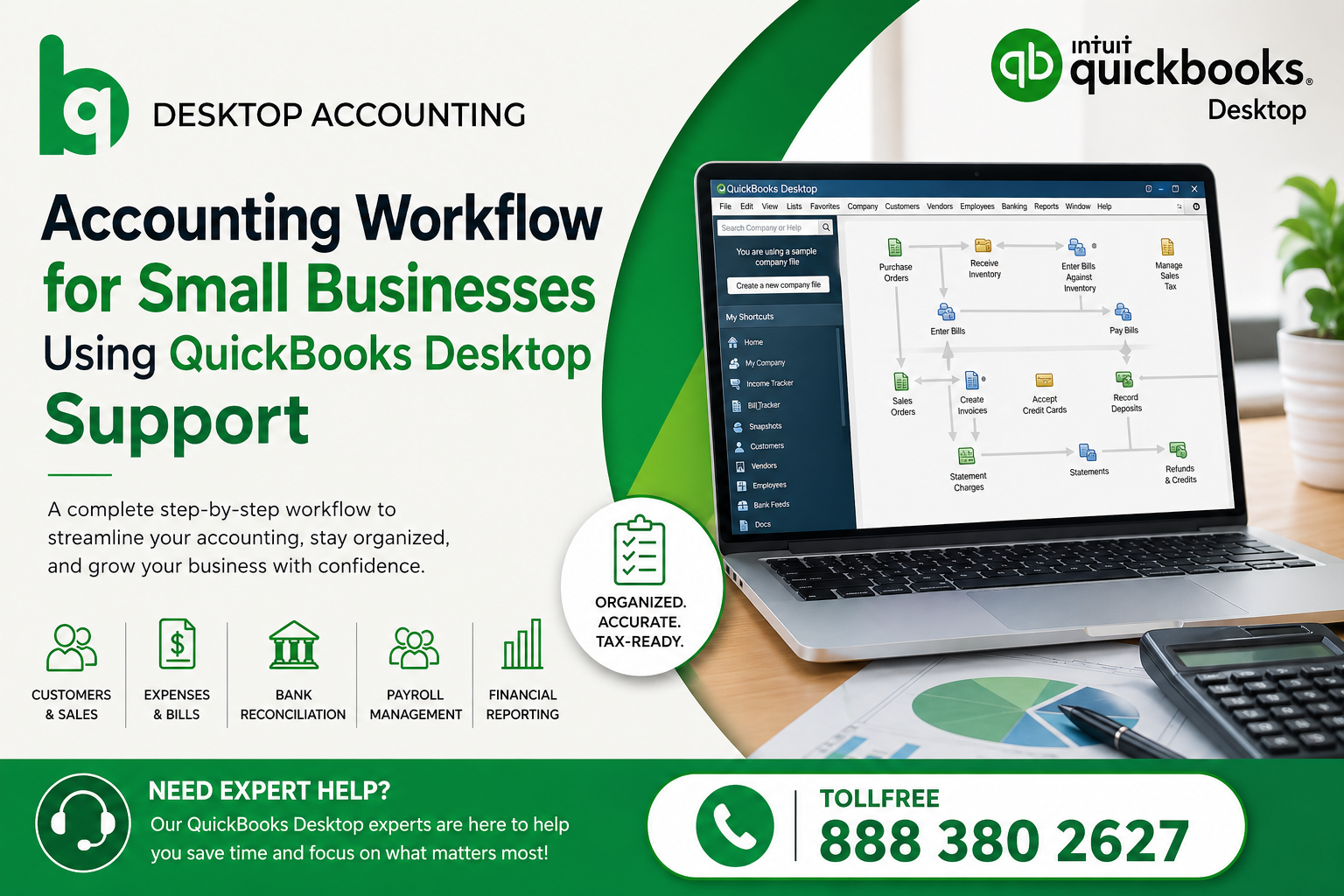

Operating a small business requires wearing multiple hats, and one of the crucial ones is financial management. With inadequate accounting procedures in place, a business can experience such challenges as cash flow issues, delayed tax payments, and expensive mistakes, even if it is running at a profit. QuickBooks Desktop support software, QuickBooks accounting services, and bookkeeping services continue to be an extremely reliable solution for small business accounting. It is far superior compared to any other cloud-based tool due to its functionality and capabilities.
Here is how you can create a step-by-step accounting workflow in QuickBooks Desktop support, QuickBooks accounting services, and small business accounting solutions — from setting up your business to month-end closure.
Why QuickBooks Desktop support for Small Businesses?
Before outlining the workflow process, there is a need to explain why some small businesses still use QuickBooks Desktop support services, QuickBooks certified experts, and accounting software solutions rather than a cloud-based product:
- Superior reporting with more customization options
- Does not require constant internet access to operate
- Deals with intricate tasks, like inventory management, job costing, and payroll
- Industry-specific versions for different small businesses
- Well-known interface trusted by CPAs throughout North America
Let’s get started.
Step 1: Set Up Your Company File Correctly
It all begins with setting up your company file. On opening QuickBooks Desktop support, QuickBooks installation and setup services, for the first time, the Setup Assistant will prompt you to create your company file.
Key actions:
- Input your company name, address, EIN number, and starting date of the fiscal year
- Identify the industry in which you operate (the program will automatically create a suitable chart of accounts for your industry)
- Select your accounting method (either cash or accrual) and consult your accountant if uncertain about the decision
- Set the closing date to avoid any changes made on historical data
Pro tip: Take ample time to customize your chart of accounts for better financial management and business accounting accuracy.
Step 2: Connect Your Bank and Credit Card Accounts
Manual entry of information takes much time and is prone to mistakes. In the program QuickBooks Desktop support with bank feeds and accounting automation, there is an option for bank feed imports, and it saves you hours of manual work each month while eliminating most reconciling mistakes.
How to set it up:
- Go to Banking -> Bank Feeds -> Set up Bank Feed for an Account
- Find your bank from the list and log into the account
- Connect and download new transactions often (daily/weekly)
- Reconcile transactions in the Bank Feeds Center
Step 3: Record Daily Transactions
Consistency of daily record keeping is essential for efficient bookkeeping services and accounting services for small businesses. Being up-to-date will help avoid the dreaded last-minute catch-up exercise.
Sales & Income:
- Invoices – for credit sales (money owed to you)
- Sales Receipts – for cash transactions
- Deposits – when you collect your invoice payments
Expenses & Bills:
- Expense – for small one-time transactions
- Bills – when receiving bills from your vendors (that you need to pay later)
- Checks/Enter Credit Card Charges – for immediate payment transactions
Step 4: Manage Accounts Receivable (AR)
Invoices not paid cause problems with cash flow. QuickBooks Desktop support and accounts receivable management solutions provide you with advanced features that help manage receivables efficiently and improve cash flow management.
- Generate an A/R Aging Summary report every week (Reports > Customers & Receivables)
- Issue invoice reminders within QuickBooks for any late invoices
- Record customer payments immediately upon receipt
- Create Memorized Transactions for invoices that recur regularly to save time
- Specify the payment terms for each invoice (Net 15, Net 30)
Step 5: Manage Accounts Payable (AP)
Knowing how much you owe and when you owe it is just as critical as getting paid. Proper A/P management helps maintain good relationships with vendors and avoids unnecessary penalties for delayed payments.
- Add vendor invoices as soon as you receive them
- Generate the A/P Aging Summary report weekly to know your future payment schedules
- Plan your payments so you can benefit from early payments discounts
- Use 1099 reporting for contractors you hire that earn more than $600 per year
Step 6: Reconcile Your Accounts Monthly
Reconciliation is not optional. It is an assurance that everything you see in your QuickBooks book matches what is seen in your bank account. This process is mandatory before the end of each month.
How to reconcile in QuickBooks Desktop:
- Open Banking > Reconcile
- Pick an account and input the date and balance of the statement
- Mark transactions found on your bank statement
- The difference should be $0.00 — find out why there’s a discrepancy before reconciling
Step 7: Review Your Financial Reports
When you’ve reconciled your books, produce your basic accounting statements to analyze how well your company is doing. Plan to set aside some time each month-end to study them.
- Profit and Loss Statement (Income Statement) — indicates income, expenditures, and bottom line
- Balance Sheet — reflects assets, obligations, and capital
- Statement of Cash Flows — reveals flow of funds in and out
- Budget versus Actual — compares your achievements against budgeted numbers
Step 8: Close the Month and Prepare for Tax Time
Before month-end, set a closing date in QuickBooks Desktop (Edit > Preferences > Accounting > Set Closing Date) and then password-protect it so that you do not inadvertently modify a closed accounting period.
Year-end tax prep checklist:
- Reconcile all accounts to December 31
- Prepare a trial balance report and send to your CPA
- Prepare 1099 reports for qualified subcontractors
- Check depreciation reports on fixed assets
- Back up your company data file prior to making any year-end adjustments
By submitting an error-free accounting report to your CPA at year-end, you will save time and money.
Bonus Tips for a Smoother Workflow
- Backup every day using either a hard drive or a cloud-based solution
- Utilize classes and locations to measure profit and loss by department or location
- Memorize any report that you frequently use to be available with a single click
- Restrict user permissions and grant users only those privileges that they require
- Upgrade QuickBooks to obtain new features and updates for your business
If you are looking for reliable and professional QuickBooks Data Migration Services, QB Desktop Accounting provides expert solutions to help businesses securely transfer and manage their accounting data with accuracy and efficiency. Their team specializes in QuickBooks data migration, company file conversion, data recovery, setup, and troubleshooting services for businesses of all sizes.
Whether you need to migrate data from QuickBooks Desktop to QuickBooks Online, transfer accounting files between systems, or upgrade to a newer QuickBooks version, their experts ensure a smooth and secure migration process with minimal downtime. They also assist with payroll setup, financial data management, bookkeeping support, and QuickBooks performance optimization to help businesses maintain accurate financial records.
With professional support and industry expertise, QB Desktop Accounting helps businesses simplify accounting operations, improve productivity, and ensure seamless QuickBooks data management.
Conclusion
An efficient accounting process in QuickBooks Desktop support, accounting services, and bookkeeping services does more than merely ensuring that your accounts are balanced. It provides financial insight, improves cash flow management, and supports better business decisions.
Frequently Asked Questions (FAQs)
Q1: What is the difference between QuickBooks Desktop and QuickBooks Online?
QuickBooks Desktop provides enhanced features such as financial reporting, inventory management, and accounting services efficiency, while QuickBooks Online is cloud-based.
Q2: How often should I update my books in QuickBooks Desktop?
Regular updates improve bookkeeping accuracy, accounting services efficiency, and financial management.
Q3: Can I handle payroll inside QuickBooks Desktop?
Yes, with built-in QuickBooks payroll support services and tax preparation services, including automated tax calculations.
Q4: What should I do if my bank reconciliation does not balance?
Use QuickBooks troubleshooting services and financial reporting tools to identify discrepancies.
Q5: How do I share my QuickBooks Desktop file with my accountant?
Use Accountant’s Copy for seamless collaboration with QuickBooks certified experts and accounting professionals.